Big Monster Slippers
A sourcing note on oversized plush footwear: the silhouette is the easy part, the sole is the hard one
The claw tip is where an order is won or lost. A 40 cm dinosaur claw slipper can look flawless on a sample table and still generate complaints three weeks after launch, because the extra nine centimetres of plush hanging past the toe box is dead weight, and dead weight on a soft sole is what turns a novelty slipper into a trip hazard.
That is the short version. In oversized monster slippers the character is the marketing and the construction is the product. Sizing tolerance, sole compound, plush density, theme selection and seasonal timing are the five things that decide whether a style repeats or gets cancelled, and they are the five things this article works through.
Why big plush slippers fail in the first ninety days
Most returns on oversized animal and monster slippers cluster around three physical failures rather than design taste. The first is toe collapse: a head, horn or claw that extends beyond the footbed has no support underneath it, so the plush pile mats down and the shape sags within weeks of daily wear. The second is upper separation at the sidewall, where a tall character body pulls against a lightweight outsole. The third is footbed compression: a flat layer under the ball of the foot loses thickness faster under a heavy, wide silhouette, and once it does, the wearer feels the floor through the shoe.
None of these show up in a photograph. All three show up in a wear trial, which is why a sample review that only checks colour matching and character proportions tells you almost nothing about the shipment.
The corrective is boring but effective: build the oversized shape on a footbed that can carry it. A reinforced toe box, a sidewall bond that runs the full perimeter rather than spot-glued sections, and a midsole that stays above a defined compression threshold after repeated loading. Factories already running plush animal slippers for kids at volume have usually solved this at the pattern stage, because a collapsing claw is a pattern problem before it is a quality-control problem.
Defining "big" in numbers both sides can measure
Ask two suppliers for a 30 cm monster slipper and you will get two different products, because "30 cm" can mean the footbed, the finished silhouette, or the packaging cavity. Pin the definition down before a single price is quoted:
- Footbed length — the flat surface the foot stands on, measured from heel seam to toe seam.
- Finished length — the full silhouette including head, horn or claw overhang; this governs carton size and freight volume.
- Finished height — outsole to the highest point of the character, which drives shelf display and shipping density.
| Size band | Footbed length | Typical finished length | Main risk |
|---|---|---|---|
| Kids 24–30 | 15.5–18 cm | 22–27 cm | Toe overhang catches on stairs |
| Kids 31–34 | 19–21.5 cm | 26–31 cm | Uneven filling in the character head |
| Women 36–40 | 23–25.5 cm | 28–34 cm | Character weight pulls the upper |
| Men 41–45 | 26–28.5 cm | 31–37 cm | Outsole flex under adult load |
A tolerance of plus or minus 5 mm on footbed length is realistic for plush construction; plus or minus 3 mm usually means the factory is cutting after assembly rather than before, which creates its own problems at the seam. Ask for the measurement method in writing and measure the same three pairs from each size band on every pre-production sample.
Watch the gap: if finished length exceeds footbed length by more than 9 cm in kids' sizes, the toe overhang becomes a genuine walking hazard for children under six. Reduce the head scale, not the footbed.
Sole compound, tread depth and the slip question
Oversized slippers carry more mass than a standard mule, so the outsole has to do more work. Three constructions dominate: moulded TPR for grip and rebound, EVA for lightness, and rubber for the heaviest silhouettes. For indoor plush styles, TPR with a tread depth of at least 2 mm and a defined heel brake is the safer default; a smooth EVA outsole on a 35 cm monster slipper is a common and avoidable mistake. The wider picture of how tread geometry affects traction is covered in this note on slip resistance in animal pattern slippers.
Testing matters more than the compound name. An inclined-plane check on a wet ceramic tile, run on production samples rather than bench prototypes, will tell you in ten minutes whether the tread you approved actually works on the surface your customers have in their bathrooms.
Claim carefully: "non-slip" is a regulated or restricted claim in several markets. Describe the tread and the surface that was tested instead, and keep the test report with the shipment documents.
Plush density is the number that decides repeat purchase
Two slippers can look identical in a photograph and feel completely different after a month. The variable is usually pile density, expressed in grams per square metre. Short-pile plush in the 260 to 320 gsm range holds a character shape crisply and resists matting. Heavier long-pile fabric feels plusher at unboxing but flattens faster on a claw or horn that gets pressed by every step. Filling quality matters just as much: a polyester cluster fill that stays lofted beats a cheaper sheet fill that migrates to one side of the head.
The character sells the first pair. The sole, the seam and the pile density sell the second one.
Washability is the follow-on question every retail buyer eventually asks. Plush uppers survive a cold, gentle machine cycle when the seam allowance is generous and the filling is bagged rather than loose. They do not survive a hot cycle with a fast spin. If your market expects machine washing, agree the cycle with the factory before the order, not after the first complaint arrives.
Matching monster themes to the shelf they sit on
Monster and creature themes behave differently across age bands. Children's ranges reward exaggeration: an oversized shark head, a claw that reads as a claw from three metres away, a horn that catches light on a shelf. Teen and adult ranges reward restraint, where the same creature idea is reduced to a cleaner silhouette in a palette that survives being worn around the house in daylight.
Working examples make the split obvious. A dark grey shark style leans on a wide head and visible teeth for shelf impact, and it photographs well in three-quarter view because the teeth break the outline.
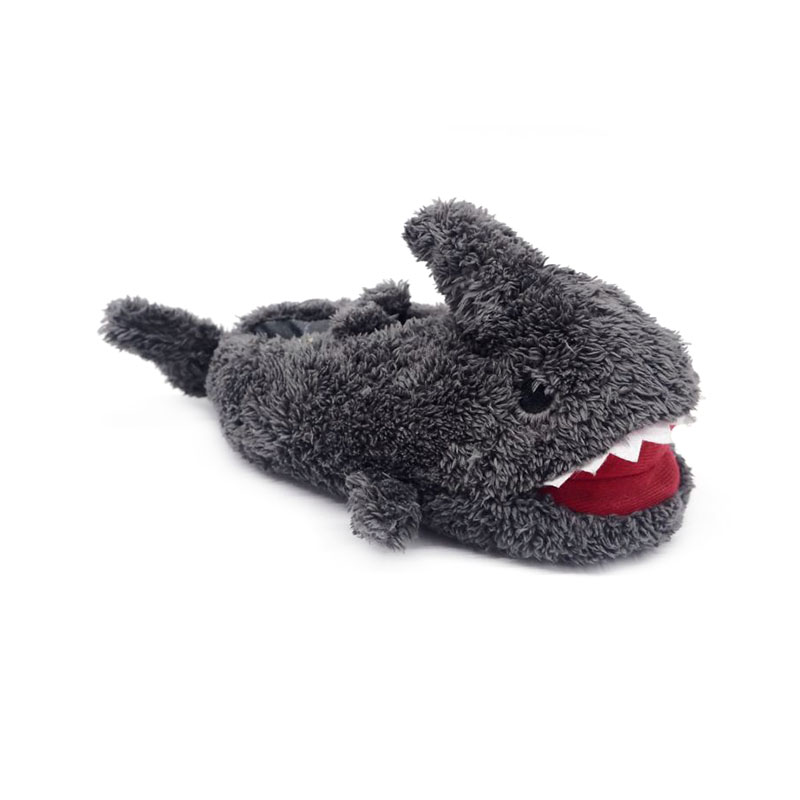 Dark Grey Scary Shark Children's Plush SlippersDark grey cartoon shark slippers in warm arctic fleece, with a wide toothy silhouette that stands out on shelf and in three-quarter product photos.View Product →
Dinosaur claw shapes sit in a different category again. They sell on the walking experience, because the claw flexes as the wearer moves, so the pattern has to keep the toe box supported while the claw tip stays free. Balance that correctly and the style repeats season after season; get it wrong and the claw folds over in the first fortnight.
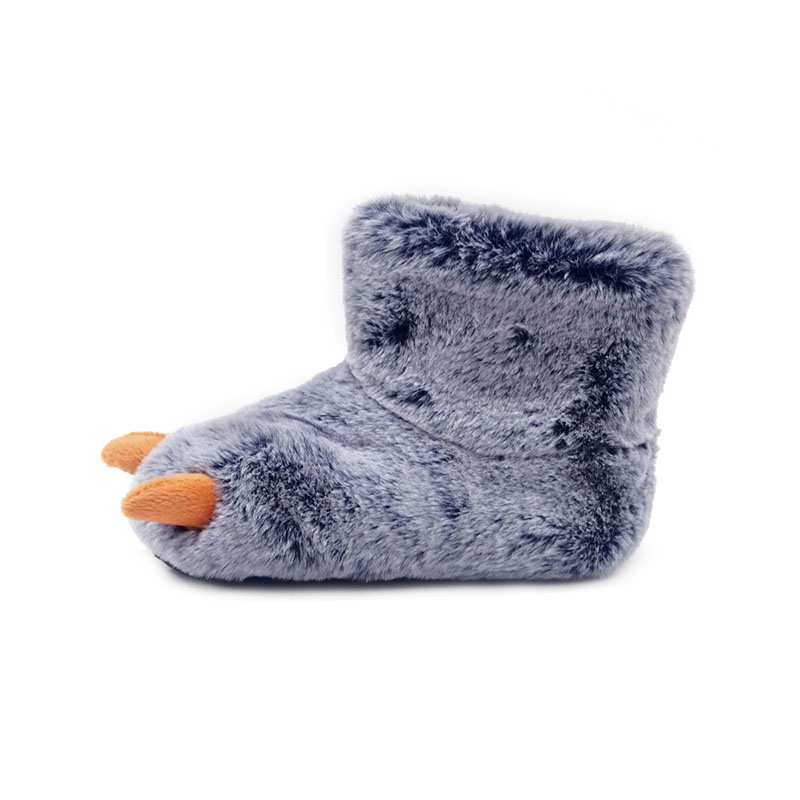 Dinosaur Paw Indoor Slippers for Women and ChildrenJurassic-themed claw slippers in two-color rabbit fur with brushed lining, made for warm indoor lounging and play while keeping the flexing paw shape clear.View Product →
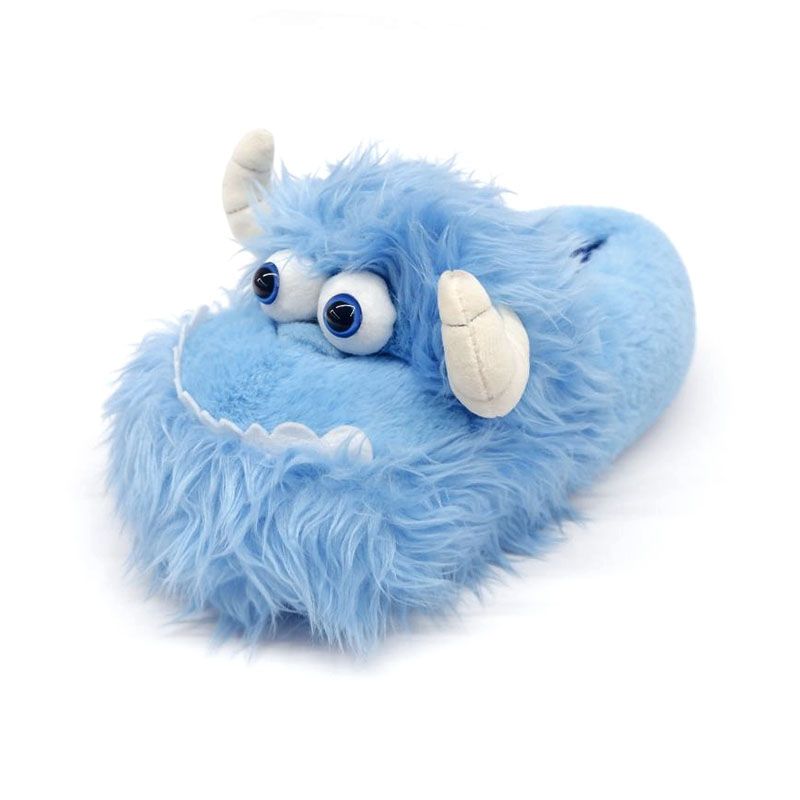
At the younger end of the market, softer monster silhouettes with rounded features and no hard edges convert better than aggressive designs, especially where a parent is the actual buyer. A friendly creature in a soft sky-blue reads as approachable rather than frightening, which matters when the person paying and the person wearing are two different people.
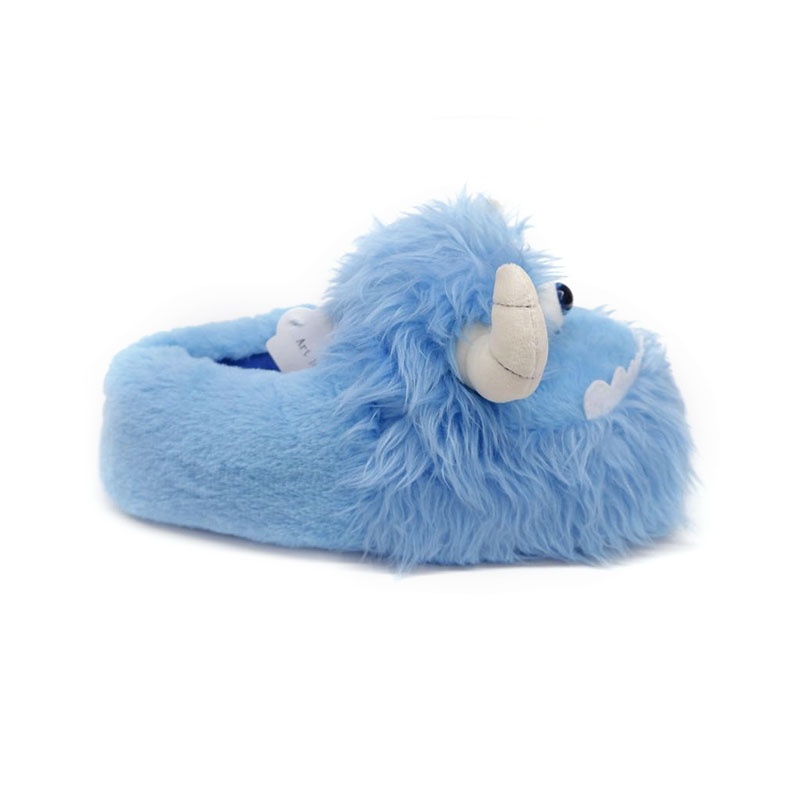 Sky Blue Monster Cow Plush Indoor SlippersPlayful sky-blue monster cow slippers in soft plush with brushed lining, designed for warm indoor winter wear and a rounded silhouette that photographs best upright.View Product →
Merchandising note: monsters photograph badly in flat pack shots. If your channel is online, request three-quarter and on-foot images with the character standing upright, because the silhouette is the product.
Season windows, order quantity and the capacity maths
Monster and animal slippers are seasonal goods with a hard cut-off. Christmas and winter programmes need goods landed six to eight weeks before the selling window, which pushes the production decision four to five months earlier. Ordering late does not simply cost margin; it forces air freight on a product with a large cubic volume, and oversized slippers are among the worst candidates for air freight because the character head is mostly air.
Capacity is worth checking rather than assuming. A mid-sized plush footwear factory with six production lines and a few hundred staff typically runs in the region of four million pairs a year across its whole range, which sounds generous until you realise that Christmas lines, winter lines and indoor lines compete for the same benches in the same eight weeks. Book the slot before the artwork is finalised.
Lead time also has a geography component. A factory near a major port such as Ningbo shortens inland transit and makes consolidated shipments easier, which matters more for mixed cartons of several monster styles than for a single-SKU container.
What to ask for: social compliance audit documentation, third-party test reports for the materials actually used, and a production timeline that names the pre-production sample date. Suppliers holding all three usually move from approval to shipment without a second round of negotiation.
A twenty-minute pre-order audit
Before you sign off, run the sample through these checks in this order. It takes about twenty minutes and catches most of what a catalogue photo hides.
- Measure the footbed of three pairs per size band and record the spread.
- Stand the slipper on a wet tile and push it forward with your palm, noting where it slides.
- Press the character head and claw tip for ten seconds and watch how quickly the pile recovers.
- Flex the outsole at the ball line and check for separation along the sidewall.
- Weigh one pair, because anything unusually light usually means a thinner midsole.
- Confirm the finished length against the carton dimension, not against the specification sheet.
What to take into the next buying round
Big monster slippers sell on personality and stay sold on structure. The silhouette earns the click, the pile density keeps the shape, the sole compound keeps the wearer upright, and a written sizing definition keeps buyer, factory and customer arguing about the same measurement instead of three different ones. None of that is complicated, but all of it has to be agreed before the first cutter lays out the plush.
If a supplier can talk you through the toe box construction, the tread depth and the fill specification without reaching for a catalogue, the monster on the shelf is probably built to survive more than one season.